
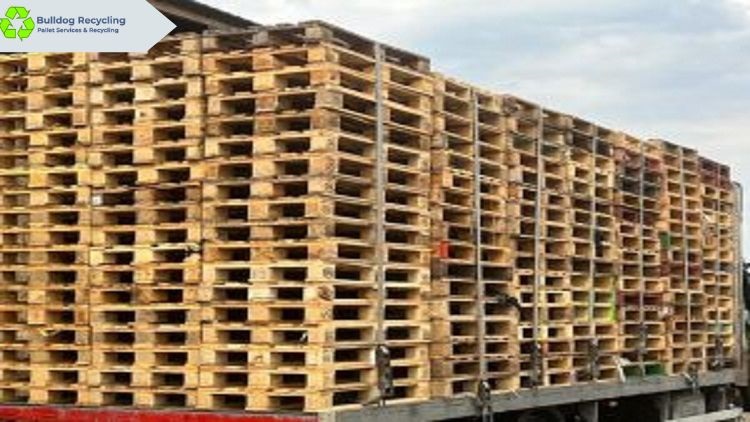
By connecting with companies specialising in recycled pallets sales in Hertfordshire or across the UK, logistics and warehousing businesses can cut overhead costs, preserve capital, become more sustainable, reduce their carbon footprint, create resilient supply chains, and future-proof their distribution networks.
A detailed discussion on the matter is available below.
Read on to know more.
How Do Recycled Pallets Make Supply Chains Efficient?
Recycled pallet sales in Hertfordshire, for instance, make logistics businesses and warehouses efficient in the following ways.
Dramatic Cost Reductions and Capital Preservation
Running a business is costly.
If there are ways that can help a business owner to shave off thousands of pounds from their venture’s overhead costs, who in their right mind would stay away from said solutions?
For a logistics business or warehouse owner, bearing the costs of brand-new pallets is quite the undertaking. However, when the same business owner decides to use recycled pallets, they are shielding their company from substantial capital investments.
Additionally, using recycled pallets keeps a business owner from shelling out extra funds for the same number of pallet consignments during global timber shortages or price spikes.
For the best results, business owners should opt for Grade-A or Grade-B reconditioned pallets for their impressive structural integrity and low cost.
Food for thought.
Strengthening Sustainability
Back in the day, sustainability was just a corporate social responsibility buzzword. Fast forward to 2026, and it is apparent that sustainability has been repositioned as both a commercial differentiator and a strict regulatory requirement.
When a business owner decides to incorporate recycled assets, such as reclaimed timber pallets, the company directly meets the requirements of eco-conscious clients who prefer low-carbon logistics.
Decreasing Carbon Footprints Through Circular Economics
Recycling timber pallets is a form of the circular economy. Circular economies, on the other hand, are highly effective at reducing carbon footprints.
Here is the explanation. When every piece of timber in a pallet is repaired and reused, one tree is saved from being chopped down, processed, transported, and made into a pallet. When these processes are prevented from occurring altogether, greenhouse gas emissions are curbed.
By adopting pallet recycling, businesses keep their operations from entering the take-make-waste cycle. It is that simple.
Boosting Supply Chain Resilience and Local Sourcing
The world runs on supply chains. Global logistical networks, however, are extremely vulnerable. A supply chain can crumble like a house of cards amid regional, national, continental, or global geopolitical turmoil.
What happens immediately after a supply chain breaks or crumbles?
Issues like cross-border delays and raw material scarcities manifest.
How to shield your warehousing or logistics business from these problems?
You can start by relying on local recycling networks that run on closed loops.
Here is an example: a business that relies on localised (and established) networks for pallet sales in Hertfordshire can expect predictable, consistent lead times.
That alone makes this localised approach attractive enough for business owners.
Why?
Well, a business will be shielded from the volatility of international freight markets.
Additionally, it will be ensured that the business in question’s shipping schedules remain uncompromised.
Future-Proof Your Distribution Networks One Pallet At A Time
Distribution networks embracing the recycled timber movement ensure their daily operations become smarter and leaner.
Back in the day, timber pallets were considered expendable, disposable. Those days are long gone. Timber pallet recycling specialists like Bulldog Recycling are ensuring timber pallets are repurposed as a multi-use asset.
In the end, businesses that adopt pallet recycling protect their bottom lines and contribute indirectly to keeping the planet habitable for a while longer. Additional benefits include a resilient infrastructure that can weather economic fluctuations and resource scarcity during geopolitical turmoil.
If you run a business and haven’t adopted pallet recycling yet, this is the best time to do so, don’t you think?